
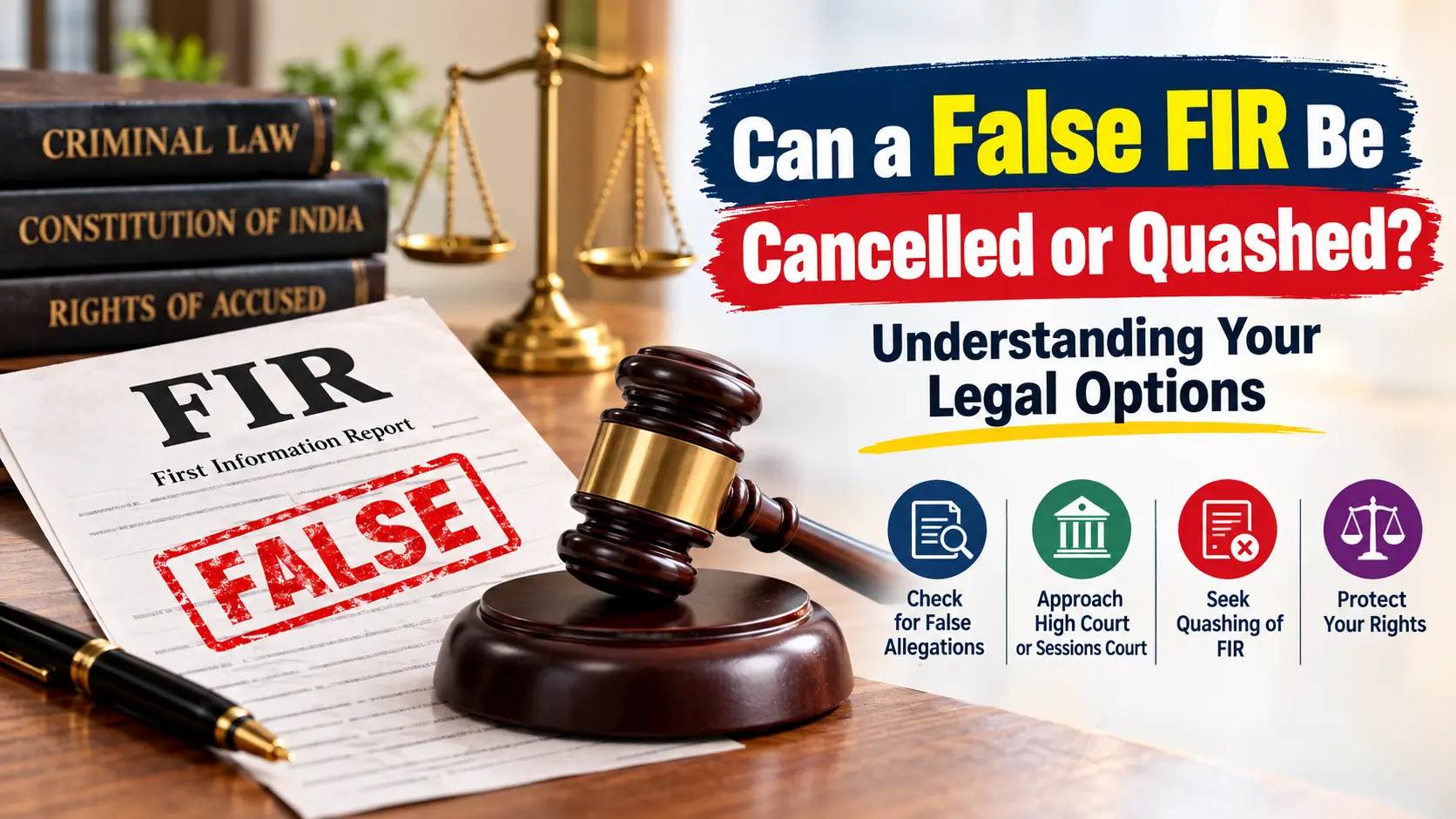
Can a False FIR Be Quashed?
A false FIR can have damaging legal consequences for a person. However, an FIR cannot be quashed simply based on the accused’s claim that the allegations are false.
An FIR can be quashed in the High Court even if the allegations are found to be true if they do not disclose a criminal offence, if the allegations are so absurd that they are impossible to be true, or for other legitimate reasons.
The High Court could also quash the FIR proceedings if continuing with the criminal case would constitute an abuse of the judicial process.
What Is FIR Quashing?
Quashing of FIR in a way means a legal remedy used by the High Court to quash a First Information Report (FIR) against someone or quash criminal proceedings if there are valid legal grounds for doing so.
People normally file a petition in the High Court to quash FIR as the High Court has the legal power to quash criminal proceeding against a person when the situation so demands.
Quashing of FIR is different from FIR cancellation. FIR cancellation usually takes place when the investigating agency completes its investigation and submits a final or cancellation report to the Magistrate.
What Is Section 482 CrPC?
This provision deals with the inherent powers of the High Court to prevent abuse of the judicial process. Section 482 CrPC provides that the High Court can quash a FIR or criminal proceedings when there are proper grounds for doing so.
In the new criminal procedure code, Section 528 of BNSS deals with the powers similar to Section 482 of the CrPC. However, the phrase ‘Section 482 CrPC’ is nonetheless frequently used when people want to search about quashing of FIR.
The Section 482 is not an automatic remedy for cancelling a FIR.
Grounds for Quashing a False FIR
Not all false allegations will result in the FIR being quashed. Each case will depend upon its own merits and the legal grounds.
Some of the major grounds for quashing FIR are discussed below:
1. FIR Does Not Show a Criminal Offence
When the facts of the FIR do not meet the essential ingredients of the alleged offence, the High Court may quash the FIR.
2. No Cognizable Offence Is Disclosed
If the FIR does not contain any cognizable offence, the legality of the police investigation could be questioned.
3. Allegations Are Absurd or Impossible
When the allegations are so unreasonable and far-fetched that they cannot possibly be true, then the High Court may quash the FIR.
4. Criminal Case Is Barred by Law
Sometimes a specific law bars a criminal prosecution. In such cases, the FIR could be quashed on the grounds of the bar by law.
5. Mala Fide or Malicious Proceedings
If materials are presented showing that the criminal proceedings were initiated out of revenge or malice, then the High Court may decide to quash them.
6. Civil Dispute Given a Criminal Colour
Some civil or commercial disputes are sometimes dressed up in the colour of crime to harass the opposite party. In such cases when the essential ingredients of a crime are not fulfilled, the court may quash them.
7. Abuse of the Legal Process
If proceeding further with the criminal proceedings would be an abuse of the legal process, then the High Court may quash the FIR.
The grounds for quashing FIR do not cover all cases. The court will consider the merits of the case, the allegations, and the legal position of the accused before quashing a FIR.
Can an FIR Be Quashed During Investigation?
Yes, an FIR could be quashed even during the investigation. However, the High Court usually avoids quashing an FIR unless the circumstances particularly demand so.
Filing a quashing of FIR petition does not automatically stop the police investigation.
The Court will determine whether the quashing of FIR is justified and whether there are sufficient legal grounds for interfering with the investigation.
Can a Charge Sheet Be Quashed?
A charge sheet does not automatically bar the High Court from quashing the FIR.
The High Court may go through the FIR, charge sheet, and the relevant documents to decide whether the alleged offence was actually disclosed.
However, the High Court usually does not go through a detailed trial of the petition. It does not examine contested facts or decide issues relating to the credibility of witnesses.
Documents Needed for FIR Quashing
Depending on the case, some of the documents that can be produced are as follows:
Copy of the FIR
Complaint, if any
Charge sheet or final report, if filed
Relevant Court orders
Documents on which the accused has relied upon
Important events and dates
Documents to show a bar, contradiction or misuse of the judicial process
The mere production of documents will not be sufficient. The relevance of documents and their connection with the FIR quashing is also important.
How Can a Criminal Lawyer Help?
A criminal lawyer can help analyse the FIR, allegations and the offences mentioned in the FIR. The lawyer will help you explore the quashing remedies and legal grounds.
A criminal lawyer can assist in the following matters:
Examining the FIR and the sections mentioned therein
Determining if the essential ingredients of the alleged offences are fulfilled
Identifying grounds for quashing FIR
Addressing issues relating to arrest and bail
Jurisdiction of the High Court
Drafting FIR quashing petition and other documents
Seeking legal assistance at an early stage will help clarify the available remedies for quashing the FIR.
Do You Need an FIR Quashing Lawyer?
Filing a petition in the High Court to quash FIR will require sufficient legal grounds and documents.
An FIR quashing lawyer will be able to help you prepare the High Court petition, identify the grounds for quashing the FIR and help arrange the documents to support the petition.
An FIR quashing lawyer can also help you determine on the issue of abuse of the legal process.
However, the final decision to quash the FIR will be taken by the High Court.
When Is a Supreme Court Lawyer Needed?
Quashing of FIR is normally done in the High Court. A Supreme Court lawyer may come into the picture when the matter reaches the Supreme Court.
Supreme Court lawyer may be needed in the following circumstances:
When a case reaches Supreme Court after challenging a High Court decision
When a case comes up in Supreme Court through appropriate proceedings
When representation before the Supreme Court is needed
When a question of law arises that requires the attention of the Supreme Court
Whether a Supreme Court lawyer is needed will depend upon the proceedings and the remedy sought.